

Standing in a hardware store staring at ceiling fans is one of those experiences that should be simple but somehow isn’t.
Blade spans, CFM ratings, downrod lengths, DC motors, wet ratings — and that’s before you’ve even looked at the styles. You came in to buy a fan and now you feel like you need an engineering degree just to leave with the right box.
Most guides online don’t help much either. You either get a vague three-paragraph overview that leaves you with the same questions you started with, or some 18-step monster that makes buying a ceiling fan feel like filing your taxes.
This guide is different. I’ve researched ceiling fans obsessively for years, installed multiple fans across my own home, and made enough mistakes along the way to know exactly where people go wrong. This covers everything that actually matters — in the order it matters — without the fluff.
By the end you’ll know exactly what to buy. Let’s start with the most important decision of all: size.
Here’s what’s covered:
- How to size a fan for any room
- Flush mount vs downrod — which one your ceiling needs
- DC vs AC motors — the real difference
- What CFM means and why it matters
- Indoor vs outdoor ratings explained
- Style, light kits, controls, budget, and installation
Step 1: Get the Size Right (This Is the Most Important Thing)
I’ll be direct: size matters more than any other single decision you’ll make about a ceiling fan.
I’ve seen tiny fans in huge living rooms that barely disturb the air — decorative spinning objects with zero practical effect. I’ve also seen massive fans crammed into small bedrooms that look like someone tried to land a helicopter on the ceiling. Both are avoidable. And both come down to one thing: getting the blade span right for your room.
Measure your room first — don’t guess
Grab a tape measure. Find the length and width of your room in feet, then multiply them together. That’s your square footage.
A 12 x 14 foot bedroom? That’s 168 square feet. A 15 x 20 living room? That’s 300 square feet. Simple.
For open-plan spaces where your kitchen flows into a dining area, measure the full combined space. Then position the fan in the middle of the shared area and size it for that total square footage.
The blade span chart
Once you have your square footage, find it in this table. That’s your blade span target.
| Room size (sq ft) | Blade span |
|---|---|
| Up to 75 sq ft | 29–36 inches |
| 76–144 sq ft | 36–42 inches |
| 145–225 sq ft | 44–50 inches |
| 225–400 sq ft | 50–60 inches |
| Over 400 sq ft | 60+ inches (or consider two fans) |
Most standard US bedrooms land between 130–175 sq ft, which puts you firmly in the 42–48 inch range. Most living rooms fall in the 44–52 inch zone.
When in doubt, go slightly larger. A fan that’s a touch big for the space moves air more efficiently than one that’s too small to do anything useful.
Room shape matters too
Not every room is a tidy square. A few things worth knowing:
Long, narrow rooms — like galley kitchens or hallways — do better with two smaller fans positioned along the length of the space rather than one large central fan. One fan at the center of a 10-foot wide hallway isn’t going to do much for the far ends.
Square rooms with one central ceiling box are the easiest case — one well-sized fan in the middle handles the whole room comfortably.
Large open-plan spaces connecting kitchen, dining, and living areas need a big fan (52–60 inches minimum) positioned roughly in the middle of the combined zone, or two separate fans if the space is genuinely large.
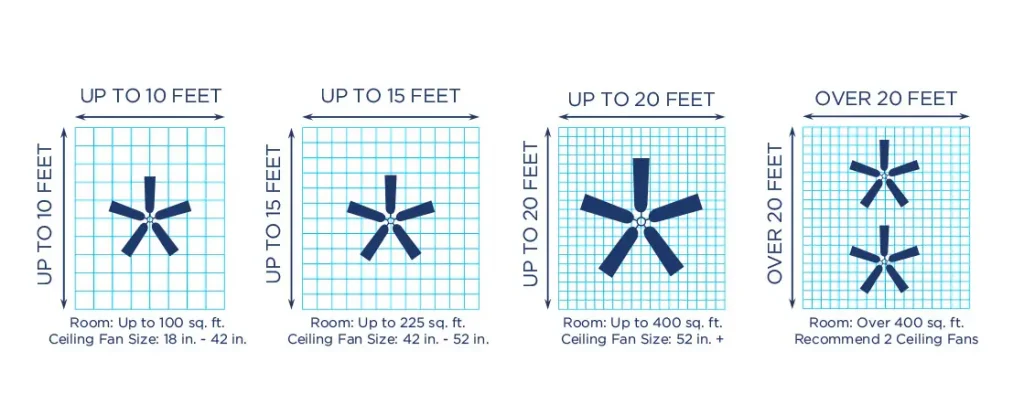
For a more detailed room-by-room breakdown, see my ceiling fan size guide.
Step 2: Figure Out Your Ceiling Height — This Decides Your Mounting Type
Once you know the blade span you need, ceiling height tells you how the fan mounts. Get this wrong and even a perfectly-sized fan will look off and perform badly.
The rule that matters most
Blade tips need to be at least 7 feet above the floor. That’s the safety minimum — anything lower and tall people are ducking, and building codes in most US states require it. The ideal is 8–9 feet from floor to blade for optimal air circulation. Too close to the ceiling reduces airflow efficiency significantly.
Three ceiling scenarios and what each means
Ceiling 8 feet or lower: Flush mount
A flush mount fan (also called a hugger fan) attaches directly to the ceiling without a downrod. It keeps blade clearance safe and is the only sensible option for low ceilings.
Not all fans come in flush mount versions — when shopping, look specifically for “flush mount” or “hugger” in the product description. Most 42–48 inch fans have flush mount options available.
Ceiling 9 feet: Standard downrod (usually included)
Most fans ship with a 3–6 inch downrod in the box. For a 9-foot ceiling, this is typically fine as-is — no extra purchases needed. This is the easiest scenario.
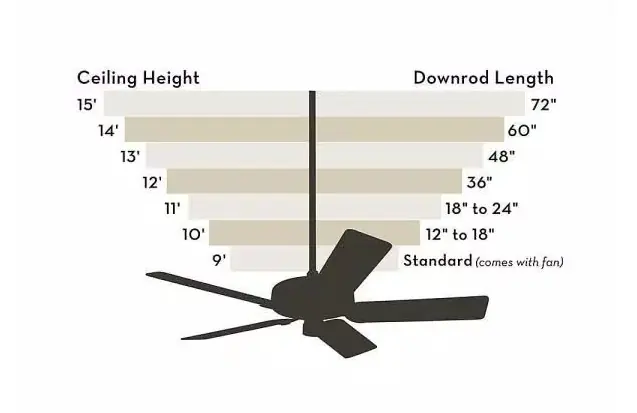
Ceiling 10 feet or higher: Longer downrod needed
Here’s where people get caught out. The fan that comes in the box with its standard 4-inch downrod looks ridiculous on a 12-foot ceiling — too high up to move air effectively, and visually awkward.
The formula is simple:
Ceiling height minus 9 feet = downrod length needed
| Ceiling height | Downrod length |
|---|---|
| 8 ft | Flush mount — no downrod |
| 9 ft | 3–6 inch (usually included) |
| 10 ft | 12 inch |
| 11 ft | 18–24 inch |
| 12 ft | 36 inch |
| 14 ft | 48–60 inch |
Downrods are usually cheap — a 12-inch downrod for most fans runs about $8–15 on Amazon. Buy it at the same time as the fan so you’re not doing a second trip.
Sloped and vaulted ceilings
If your ceiling is angled, you need an angled mounting bracket — also called a sloped ceiling adapter. Not all fans include this. Check before buying.
Measure from the lowest point of the slope (not the peak), then add 6 inches to your calculated downrod length. This gives you comfortable clearance even at the low end.
I made the mistake once of assuming the included downrod was fine on a 10-foot ceiling. The fan sat too close to the ceiling, barely circulated air, and just looked wrong in the room. A 12-inch downrod from Amazon fixed it for about $10. Measuring properly before buying costs nothing.
One more thing: if installing a fan where no ceiling box or wiring exists, hire a licensed electrician for that part. Running new wiring isn’t a DIY job for most people and requires permits in most US states.
Step 3: Understand CFM — It Tells You How Well a Fan Actually Works
CFM stands for Cubic Feet per Minute. It measures how much air a fan moves every single minute.
Plain English version: it’s basically a score for how hard the fan actually works. A fan with high CFM moves a lot of air. A fan with low CFM is mostly just spinning and looking decorative.
What CFM should you look for?
| Room size | Minimum CFM target |
|---|---|
| Up to 75 sq ft | 1,000–2,000 CFM |
| 76–144 sq ft | 2,000–3,000 CFM |
| 145–225 sq ft | 3,000–4,000 CFM |
| 225–400 sq ft | 4,000–6,000 CFM |
CFM efficiency — the number nobody mentions
CFM efficiency is CFM divided by watts — how much air the fan moves per watt of electricity it uses. A higher number means a more efficient fan.
Energy Star certified fans must hit at least 75 CFM per watt on high speed. If your energy bills matter to you, look for Energy Star certification and a high CFM/W number.
What actually affects CFM
Blade span is the biggest factor — larger blades generally move more air. Blade pitch (the angle the blades are set at — 12–15 degrees is the sweet spot) affects it too, as does motor quality and speed setting.
Honestly though: if you match blade span to room size correctly using the table in Step 1, any decent fan in the right category will hit adequate CFM numbers. CFM comparisons become useful when you’re choosing between two similar-looking fans and trying to figure out which one actually performs better.
Step 4: DC Motor or AC Motor — Here’s What Actually Matters
This question generates a lot of debate online. Here’s the honest version without the noise.
AC motors are the traditional type. Most ceiling fans still use them. They’re cheaper, have fewer speed settings (usually 3), run slightly louder than DC, and are completely fine for the majority of situations.
DC motors are more efficient — they use up to 70% less electricity than AC motors. They’re quieter, have more speed settings (typically 6+), and generally reverse direction more smoothly. They cost more — usually $30–80 extra over an equivalent AC motor fan.
Here’s the practical comparison:
| AC Motor | DC Motor | |
|---|---|---|
| Price | Lower | Higher |
| Noise | Slightly more | Very quiet |
| Energy use | Standard | Up to 70% less |
| Speed settings | Usually 3 | Usually 6+ |
| Best for | Kitchens, garages, budget builds | Bedrooms, living rooms, anywhere quiet matters |
My actual take: for a kitchen or garage where you’re not sitting quietly underneath it for hours — AC is genuinely fine. For a bedroom or living room where you’ll notice every bit of hum and noise — DC is worth the extra money. That’s how I’d make the call.
For a full breakdown with real examples, see my DC motor vs AC motor comparison.
Step 5: Indoor vs Outdoor — Check the Rating Before You Buy
This one catches people out more than almost anything else. Not all ceiling fans can go in all locations — and the rating is printed right on the box.
Three ratings, explained simply
Dry rated is a standard indoor ceiling fan. Fine for bedrooms, living rooms, and dining rooms. Cannot handle moisture or humidity. Do not put a dry-rated fan in a kitchen, bathroom, or anywhere outdoors — the motor will deteriorate.
Damp rated has a sealed motor housing that handles humidity. Safe for kitchens, bathrooms, covered patios, and enclosed porches. Cannot handle direct water exposure. This is what most people actually need for kitchen ceiling fans — and what the previous buying guide on this site consistently got wrong by recommending dry-rated fans for kitchens.
Wet rated is built for direct exposure to rain and weather. Use for uncovered outdoor areas. Wet-rated fans are also fine anywhere a damp-rated fan would go — it’s the safer option whenever you’re unsure.
Quick rule to remember: if there’s steam, humidity, or any chance of moisture — damp-rated minimum. If it’s fully exposed to the elements outdoors — wet-rated.
| Location | Minimum rating needed |
|---|---|
| Bedroom / living room | Dry |
| Kitchen / bathroom | Damp |
| Covered patio / porch | Damp |
| Open outdoor area | Wet |
[AD SLOT 3]
Step 6: Style and Finish — Make It Look Like It Belongs
Performance matters. But a ceiling fan is also a permanent design element in your room. The right finish makes the fan look intentional. The wrong one makes it look like it was installed by whoever lived there before you and never changed.
Common finishes and where they work
Matte black is having a genuine moment right now and for good reason. It looks incredible against white or light-wood kitchens, pairs naturally with black cabinet hardware and light fixtures, and works in any modern or contemporary room. If your hardware is already black, this is essentially a no-brainer.
Brushed nickel / satin nickel is the most versatile finish on the market. Works in almost any room without clashing. The safe choice if you’re genuinely unsure what to pick.
White blends into white or light ceilings and makes the fan visually disappear. Good for small rooms where you don’t want the fan to dominate, or anywhere minimalist and airy is the goal.
Oil-rubbed bronze / aged bronze has a warm, slightly worn tone that pairs beautifully with farmhouse, rustic, or traditional interiors. Works well alongside wood tones and warm-coloured walls.
Brass / gold is having a design moment in 2026. Works in maximalist, eclectic, or Art Deco spaces. Not for every room — but when it works, it looks genuinely striking rather than generic.
Blade materials
Wood or wood-look blades add warmth and work well in farmhouse and rustic settings. ABS plastic blades are lightweight and durable — good for outdoor use. Metal blades lean industrial and are extremely durable.
[IMAGE — Style comparison] NanoBanana prompt: “four ceiling fan finish styles side by side — matte black, brushed nickel, white, bronze — in modern home settings, clean editorial photography, Pinterest style” Alt text: “ceiling fan finish options for different interior styles — matte black, brushed nickel, white, bronze”
The simplest style rule: match your fan finish to the existing hardware in the room — cabinet handles, light fixtures, door handles. If those are matte black, go matte black fan. If they’re brushed nickel, go brushed nickel. One rule, always works, makes the fan look like it was planned rather than guessed.
Step 7: Do You Need a Light Kit?
A lot of ceiling fans come with or support an integrated LED light kit. Whether you need one depends entirely on how your room is already lit.
When to get a fan with a light kit
Get one if your room doesn’t have great overhead lighting and the fan ceiling spot is the logical place for it. It solves two problems at once — airflow and illumination — without taking up a second ceiling box. This is especially useful in kitchens and living rooms.
When to skip it
If your room already has solid overhead lighting — recessed lights, a separate pendant or chandelier — you don’t need the fan to handle lighting too. Fan-light combos can also look cluttered in rooms that are already well-lit.
What to look for if you do get a light kit
Color temperature is the one most people ignore and then regret. It’s measured in Kelvin (K). You want 2,700K–3,000K for warm, cosy light in living rooms and bedrooms. 4,000K works for task-oriented spaces like kitchens. Avoid anything above 5,000K in a home — it’s clinical and harsh.
Dimmable is worth paying slightly more for. Being able to bring the light down in the evenings changes how a room feels completely.
LED is non-negotiable now. Never incandescent — LEDs last years longer and use a fraction of the electricity.
My take: for kitchens and living rooms I almost always recommend a light kit. It’s practical, saves a ceiling spot, and means one less switch to manage. For bedrooms, only get one if the room has no other decent light source — otherwise it can make the space feel too office-like.
Step 8: Controls — Remote, Pull Chain, Wall Switch, or Smart?
How you control the fan matters more than most people think until they’ve lived with the wrong choice for six months.
Pull chain is the old standard. One chain for speed, one for light (if there is one). Completely functional but requires walking over and reaching up every single time you want to adjust anything. Acceptable in garages, utility rooms, or anywhere you turn it on and forget it. Genuinely annoying in bedrooms and kitchens.
Included remote is what most modern fans in the $60–150 range come with now. This is the minimum I’d recommend for any bedroom, living room, or kitchen. The remote usually doubles as a wall mount so it has a fixed home. Life is noticeably better with a remote — it’s one of those small things you appreciate every single day.
Wall control / receiver replaces your existing wall switch with a fan-specific control. Cleaner look than a handheld remote. Slightly more involved to set up but straightforward once you understand the wiring.
Smart / Wi-Fi connects to your phone app and integrates with Alexa or Google Home. Set schedules, adjust speed hands-free while your hands are covered in cooking, sync it with other smart home devices. Adds roughly $30–60 to the price. Worth it if you’re already using smart home tech. If you’re not, a remote is completely sufficient.
| Room | Recommended control |
|---|---|
| Bedroom | Remote minimum — smart if you use smart home |
| Kitchen | Remote or smart — hands-free is genuinely useful |
| Living room | Remote or smart |
| Garage / workshop | Pull chain is fine |
| Outdoor / patio | Remote (weather-appropriate model) |
Step 9: Budget — What You Actually Get at Each Price Point
Ceiling fans range from about $40 to well over $500. Here’s what that money actually buys — and where the real value is.
Under $80 — Entry level
AC motor, 3 speeds, basic LED light kit, remote included on most modern budget options. Perfectly functional. Finish quality is decent, not impressive. Build quality is lighter. Fine for spare bedrooms, garages, and rentals where you want something that works without spending much.
Brands to look at: Amico, addlon, Depuley.
$80–150 — The sweet spot
Better build quality, quieter operation, DC motor starts appearing in this range, more finish options, remote is standard and some smart features show up. This is where I’d spend money for any main room in the house — the jump in quality over the budget tier is meaningful without the premium price.
Brands to look at: Hunter, Hampton Bay, Prominence Home.
$150–300 — Upper mid-range
DC motor is standard here. Better airflow performance, smart controls common, more design-forward options including fandeliers and retractable blade designs. Better warranty terms. Good for feature rooms and open-plan spaces where the fan is part of the room’s visual identity.
$300+ — Premium
Top-tier DC motor performance, smart home integration as standard, premium materials and finishes, brands that take design seriously. Good for luxury renovations or statement pieces in high-visibility spaces.
Brands to look at: Modern Forms, Minka-Aire, WAC Lighting.
Honest take: the $80–150 range is genuinely where I’d spend money for a bedroom, living room, or kitchen. You get meaningful quality over the budget tier without paying premium prices for diminishing returns. Spending under $80 for a bedroom specifically — the noise difference from a better motor alone is worth the extra $30.
[AD SLOT 4]
Step 10: Installation — How Hard Is It Really?
This question deserves a straight answer rather than the usual “it depends.”
Replacing an existing ceiling fan (most common scenario)
This is the easy one. If there’s already a ceiling fan or a fan-rated ceiling box up there, this is a 1–2 hour job for most people with basic DIY confidence. Turn off power at the breaker. Disconnect the old fan. Connect three wires on the new one — black (hot) to black, white (neutral) to white, green or bare copper (ground) to ground. Most modern fans have color-coded wiring and clear instructions. Mount the bracket, hang the motor, attach blades and light kit. Done.
Installing where there’s only a light fitting
A standard light box in your ceiling is not rated to support the weight and movement of a ceiling fan. You’ll need to replace it with a fan-rated ceiling box first. This involves working in the ceiling space — not dangerous for someone comfortable with basic home improvement, but a step up from a simple swap. A handyman or electrician takes about an hour if you’d rather not do it yourself.
New wiring from scratch
Hire a licensed electrician. Running a new circuit requires permits in most US states and is not a beginner DIY project. The electrical work itself is the one part of ceiling fan installation I wouldn’t recommend doing yourself without proper experience.
| Scenario | Difficulty | Time |
|---|---|---|
| Replacing existing ceiling fan | Easy | 1–2 hours |
| Replacing light fitting (swap ceiling box first) | Moderate | 2–3 hours |
| New wiring from scratch | Hire an electrician | N/A |
I’ve swapped out fans myself in rooms that already had ceiling boxes and it’s genuinely manageable. The one time new wiring was involved, I called an electrician. Not worth getting wrong.
For a full step-by-step, see my ceiling fan installation guide.
The Quick Checklist Before You Click Buy
Go through this before purchasing. Takes two minutes and saves you a return trip.
- Measured my room (sq ft) and matched it to blade span
- Measured ceiling height — know if I need flush mount or downrod
- If downrod needed — calculated the right length using the formula
- Checked the fan’s rating (dry / damp / wet) matches my room
- Decided on motor type — DC for quiet spaces, AC fine elsewhere
- Checked CFM is appropriate for my room size
- Chosen a finish that matches my existing hardware
- Decided whether I need a light kit
- Chosen a control type — remote minimum for any living space
- Set a budget and know what I’m getting for it
[IMAGE — Person measuring room] NanoBanana prompt: “person using tape measure in empty bright room preparing to install ceiling fan, DIY home improvement, natural light, lifestyle photography” Alt text: “ceiling fan buying checklist — measuring room before purchase”
Frequently Asked Questions
What is the best size ceiling fan for a 12×12 room?
A 12×12 room is 144 sq ft. A 42–48 inch fan is ideal for this size. If you’re between sizes, go 48 inches — slightly bigger moves air more efficiently than slightly too small.
What size ceiling fan do I need for a large open-plan room?
For rooms over 400 sq ft or large open-plan kitchen-living spaces, look at 60+ inches or consider two fans positioned along the length of the space. One small fan trying to cool a genuinely large room is essentially decorative.
Can I install a ceiling fan where there’s currently only a light?
Yes, but the electrical box needs to be fan-rated first. Standard light boxes aren’t built to support the weight and movement of a fan. Swapping the box is a moderate DIY job — or hire a handyman if you’re not comfortable working in the ceiling space.
What is the difference between damp-rated and wet-rated ceiling fans?
Damp-rated fans handle humidity but not direct water contact — use these in kitchens, bathrooms, and covered patios. Wet-rated fans handle direct rain and weather — use these for fully exposed outdoor areas. When unsure, wet-rated is always the safer choice.
Is a DC motor ceiling fan worth the extra cost?
For bedrooms and living rooms, yes — the quieter operation and energy savings justify the extra $30–80. For kitchens, garages, and utility spaces where you’re not sitting quietly under it for hours, an AC motor fan is completely fine.
How long does it take to install a ceiling fan?
Replacing an existing ceiling fan takes most people 1–2 hours. Installing where there was only a light fitting takes 2–3 hours and requires swapping the ceiling box first. Running completely new wiring requires a licensed electrician and varies by job complexity.
Wrapping Up
Choosing a ceiling fan genuinely isn’t as complicated as it can feel at first.
If you get two things right — the blade span for your room size and the mounting type for your ceiling height — everything else is a preference. Motor type, finish, light kit, controls: all important, but none of them will make you regret a purchase the way getting the size or mounting wrong will.
Go back through the 10 steps. Use the checklist before you buy. And if you want help choosing a specific fan for a specific room, the kitchen fan ideas guide and bedroom fan ideas guide have specific product picks with all the specs already worked out.
You Might Also Like
- Kitchen Fan Ideas for Every Style and Space
- Flush Mount vs Downrod Ceiling Fans — Which Do You Need?
- DC Motor vs AC Motor Ceiling Fans — The Real Difference
- Best Ceiling Fans Under $100 That Don’t Look Cheap
- 10 Common Ceiling Fan Problems and How to Fix Them
- How to Install a Ceiling Fan Without Existing Wiring